
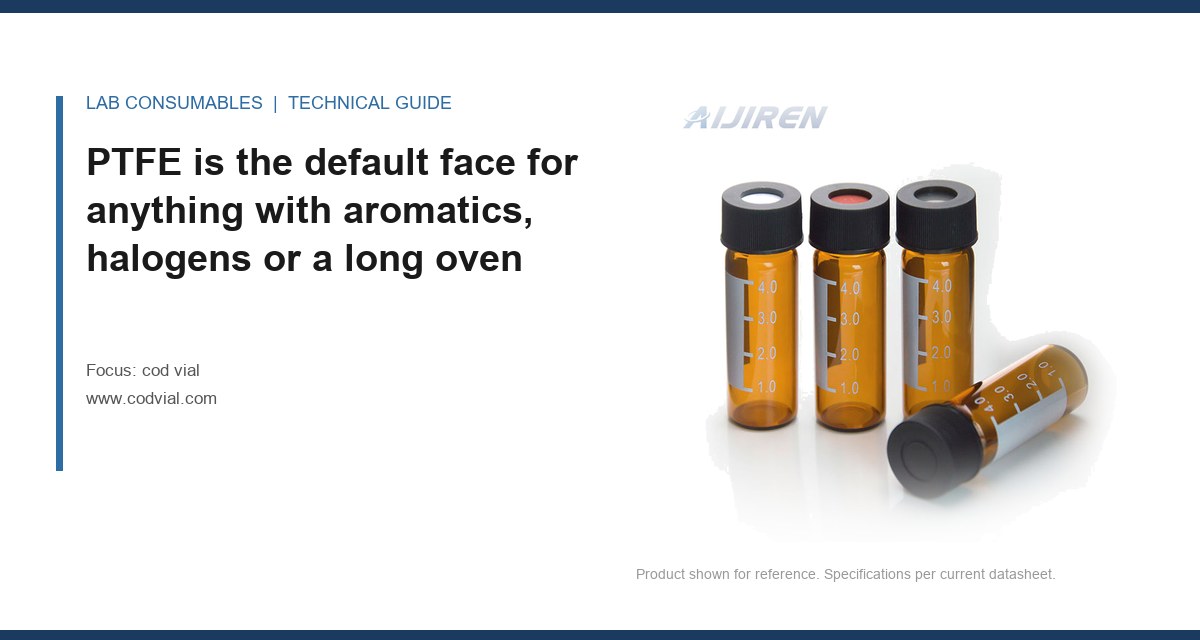
A 40 mL VOC vial capped with a silicone-backed PTFE septum sat in a 60 °C headspace oven for 38 minutes, and the run came back with toluene at 142% of its true value while the internal standard was 11% low. The method was fine. The septum was wrong. Silicone absorbs aromatic hydrocarbons, then desorbs them into the headspace over the course of a long oven cycle, and the internal standard got crowded out. We rebuilt that method with a pure PTFE-faced septum and the same lot of standard read within 3% of nominal. That is the whole argument of this article: which cod vial material to use for a given solvent and temperature is a decision you make from the polymer, not from habit.
Most of the septa I see fail in the field fail because someone matched the septum to the vial instead of to the method. The cod vial is the container. The septum is the interface, and the interface is where the chemistry happens. Below is how PTFE, silicone, EPDM, and the common laminates behave against solvents, pH, and temperature, what each wrong choice produces as a symptom, and how I narrow the choice on a new method.
PTFE is the default face for anything with aromatics, halogens or a long oven cycle
Pure PTFE is chemically inert to essentially everything you will put in a 40 mL vial at the concentrations COD and VOC methods use. It handles pH 0 to 14 without swelling. It is rated to roughly 260 °C continuous, which is far above any headspace or purge-and-trap method I have run. It does not absorb analytes the way silicone does. That last property is why it wins on aromatic and halogenated volatiles.
The tradeoff is mechanical. A bare PTFE septum is stiff and does not reseal well after a needle withdraws. Puncture it twice in the same spot and you have a leak path. A bare PTFE disc also has almost no compression memory, so it depends entirely on the cap torque to hold a seal. If you are running a 40 mL vial with a 24 mm crimp or screw cap, a pure PTFE septum works, but treat it as a single-puncture part. For methods that inject from the same vial more than once, a PTFE-faced laminate is the practical answer.
Where PTFE goes wrong is at high temperature with high torque. Over-torqued past roughly 2.5 in-lb on a screw cap, a thin PTFE disc cold-flows and thins under the cap, and you get a slow leak that shows up as a drifting internal standard over a batch. I have seen a 12-vial sequence where the last four vials lost 8 to 15% of the surrogate because the analyst used a torque driver set to 3 in-lb on PTFE-faced caps that were specified at 1.5 to 2 in-lb. The fix was not a new septum. It was a torque wrench and a written spec.
When PTFE alone is the right call
- Headspace and purge-and-trap methods with aromatic or halogenated analytes.
- Oven temperatures above 80 °C where silicone starts to contribute bleed.
- Single-injection methods where reseal is not required.
- Any method where you cannot tolerate siloxane background in a mass spec scan.
Silicone reseals beautifully and absorbs the analytes you care about
Silicone is the best resealing material in the catalog. It is soft, it closes behind a needle, and it tolerates multiple punctures, which is why it shows up on autosampler-ready caps for the 2 mL side of the bench. On a 2ml vial running a dozen injections, silicone-backed septa are fine. On a 40 mL cod vial in a heated headspace oven, silicone is a liability for volatiles.
The failure mode is absorption and desorption. Silicone swells in nonpolar solvents. Toluene, xylene, and other aromatics partition into the silicone and then bleed back into the headspace as the vial heats. In a 60 °C, 30-minute equilibration, that partition has time to reach a false equilibrium. You see it as high recovery on the aromatics and low recovery on the lighter, less soluble compounds. The internal standard, chosen for its own volatility, gets squeezed. That is exactly the 142% toluene result I opened with.
Silicone also has a temperature ceiling you should respect. Standard silicone septa are rated to about 200 °C, but the practical limit for low-bleed work is lower, around 250 °C for the better grades and much less if you care about siloxane background on a GC-MS. Above 100 °C in a sealed vial, silicone outgassing climbs and you start seeing siloxane peaks at m/z 73, 147, 207, 281. If your method scans below 300 m/z, those peaks cost you.
Where silicone earns its place
- Multiple punctures from the same vial, especially on autosamplers.
- Ambient or low-temperature methods where absorption is negligible.
- Aqueous samples with no aromatic or halogenated volatiles.
- Any application where reseal integrity matters more than inertness.
EPDM is for aqueous and polar matrices, and it is the wrong polymer for hydrocarbons
EPDM (ethylene propylene diene monomer) is a saturated hydrocarbon rubber. It is excellent against water, acids, bases, and polar solvents like methanol and acetone at moderate temperature. It has good compression set, so it reseals well, and it is cheaper than a PTFE laminate. pH range is broad, roughly 1 to 13, and it holds up to about 150 °C continuous in the right grade.
What EPDM does not do is resist nonpolar solvents. Put an EPDM septum on a vial of dichloromethane or hexane and it swells, softens, and loses compression. The symptom is a cap that was tight at the start of the run and leaks by the end. I have pulled EPDM septa off vials after a 90-minute extraction and found them visibly swollen and 20 to 30% thicker than at install. That swelling pushes the septum out from under the cap and breaks the seal.
EPDM is the right answer for aqueous COD digests, which is a real use case. A COD vial running a dichromate digest at 150 °C for two hours in a block digestor is mostly water and strong acid. EPDM handles that. PTFE also handles it, and PTFE is more inert, but EPDM reseals better if the cap is reused. The mistake is carrying EPDM over to a solvent extraction method because it worked on the digest.
EPDM decision points
- pH below 2 or above 12: EPDM is a candidate, PTFE is safer.
- Temperatures to 150 °C: EPDM is fine.
- Any aromatic, halogenated, or aliphatic hydrocarbon: do not use EPDM.
- Reusable caps where reseal matters: EPDM beats bare PTFE.
Laminates are how you get both properties, if you specify the right face
The septum most cod vials actually ship with is a laminate: a thin PTFE film bonded to a silicone or EPDM core. The PTFE face touches the sample and provides the inertness. The rubber core provides the reseal and the compression. This is the sensible engineering compromise, and it is what I specify for most 40 mL methods that inject more than once.
The catch is orientation and film thickness. The PTFE face must point into the vial. I have seen a batch of caps assembled with the laminate reversed, PTFE against the cap and silicone against the sample, and the result was a method that read clean on the first vial and drifted on every vial after. The analyst blamed the standard. The measurement that caught it was a septum blank: inject a vial of pure water, and if you see siloxane peaks, the PTFE face is not where it should be.
Film thickness matters too. A 0.05 mm PTFE film is enough to isolate the sample from the silicone for a single oven cycle. A 0.1 mm film is more robust against needle damage but stiffer. For 40 mL headspace work at 60 to 90 °C, 0.05 to 0.1 mm PTFE over silicone is the working range. The laminate also has a temperature ceiling set by the core, not the PTFE. Silicone-backed laminates are good to about 200 °C; the PTFE face is not the limit.
The laminate is also where a lot of the supply chain variation hides. Two suppliers can both call a septum “PTFE/silicone” and deliver products with different film thickness, different silicone hardness (Shore A 40 versus 50), and different bond quality. The bond matters: a delaminating septum lets the sample reach the silicone and you are back to absorption. I ask for the Shore hardness and the film thickness in writing before I qualify a lot. If a supplier cannot give you those two numbers, treat the septum as unqualified for a regulated method.
Laminate selection checklist
- PTFE face toward the sample. Verify with a septum blank on every new lot.
- Film 0.05 to 0.1 mm for 40 mL headspace.
- Silicone core for reseal; EPDM core only for aqueous, non-hydrocarbon matrices.
- Temperature ceiling is the core’s, not the PTFE’s.
- Ask for Shore A hardness and film thickness on the certificate.
Match the polymer to the solvent class before you match it to the temperature
Temperature gets all the attention, but solvent class is the first screen. A septum that is chemically wrong at 40 °C will fail before a chemically right one at 90 °C. I run the solvent screen first, then check the temperature window, then check puncture count. The table below is the decision grid I use.
| Polymer | Best solvent class | pH window | Temp ceiling (practical) | Reseal | Failure if wrong |
|---|---|---|---|---|---|
| PTFE (bare) | Aromatics, halogens, everything | 0 to 14 | ~260 °C | Poor | Leak after second puncture; cold flow under high torque |
| Silicone | Polar, aqueous | 3 to 10 | ~200 °C (lower for low-bleed) | Excellent | Absorption/desorption of aromatics; siloxane bleed |
| EPDM | Aqueous, acids, bases, alcohols | 1 to 13 | ~150 °C | Good | Swelling and seal loss in hydrocarbons |
| PTFE/silicone laminate | Aromatics, halogens, polar | 0 to 14 (PTFE face) | ~200 °C (core limit) | Excellent | Reversed orientation causes drift; delamination exposes silicone |
| PTFE/EPDM laminate | Aqueous, acids, bases | 1 to 13 | ~150 °C | Good | Hydrocarbon swelling through a damaged face |
Two notes on the table. The pH window for the laminate is set by the PTFE face, which is inert, but a pinhole or a needle track exposes the core, so the core’s pH tolerance is the real limit after puncture. And the temperature ceilings are practical limits for low-bleed work, not the absolute ratings on the datasheet. A silicone septum rated to 200 °C will still outgas enough to bother a mass spec at 120 °C.
If you are building a method around a specific regulatory requirement, the EPA SW-846 methods are the place to start, since the preservation and holding-time requirements drive the vial and septum choice. The EPA SW-846 test methods page has the current method text, and the method number tells you the matrix and the analyte class before you pick a polymer.
Two field cases where the measurement named the polymer
Case 1: the 142% toluene and the 11% low internal standard
A contract lab running a 60 °C headspace method for BTEX on 40 mL vials saw toluene recoveries climb across the batch, from 98% on vial 1 to 142% on vial 8, while the fluorobenzene internal standard fell to 89%. The pattern (aromatics up, light IS down) pointed at absorption, not at the standard. They pulled the septum spec: silicone-backed, no PTFE face. The silicone was partitioning the aromatics and the method’s 30-minute equilibration was long enough to reach a false equilibrium. The fix was a PTFE-faced laminate with a 0.05 mm film. Recoveries came back to 97 to 103% and the IS held at 100 ± 2%. They also added a septum blank per lot, which caught a second supplier’s reversed-orientation caps three months later.
Case 2: the EPDM caps that swelled 25% in a solvent extraction
A soil lab ran a solvent extraction on 40 mL vials and started seeing low recoveries on the later vials in each batch, with a visible leak at the cap. They measured septum thickness before and after the run: the EPDM septa had swelled from 3.0 mm to 3.8 mm, about 25%. The swelling pushed the septum out from under the cap and broke the seal over the 90-minute run. The method used a hexane/acetone mix, which EPDM does not resist. They switched to a PTFE/silicone laminate with the PTFE face in, and the leak stopped. The lesson was that EPDM had been qualified on the aqueous digest method and carried over to the solvent method without a re-screen. The fix cost a septum change; the cost of not catching it was a batch of out-of-spec soil results.
Both cases share a pattern: the failure was not a bad part, it was a part matched to the wrong method. The Restek technical resources have good reference material on septum selection and bleed, and the Agilent GC columns and accessories documentation covers the inlet-side consequences of septum bleed. For the sample-handling side, the Thermo Fisher chromatography and sample handling pages are a reasonable cross-check on cap and septum compatibility.
Troubleshooting: read the symptom, then the polymer
When a method drifts, the septum is often the last thing checked and the first thing wrong. Here is how I read the common symptoms back to a material choice.
- Aromatics high, light internal standard low. Silicone absorption. Switch to a PTFE face.
- Siloxane peaks at m/z 73, 147, 207, 281. Silicone bleed. Lower the oven temperature or move to a PTFE-faced laminate.
- Slow leak, drifting IS across a batch. Cold flow under over-torque, or a swollen septum. Check torque against the cap spec (often 1.5 to 2 in-lb for 24 mm screw caps) and check the polymer against the solvent.
- Septum visibly thicker after the run. Swelling. The polymer is wrong for the solvent, usually EPDM in a hydrocarbon.
- Clean first vial, drifting later vials. Reversed laminate orientation, or a delaminating bond. Run a septum blank.
- Leak only after the second injection. Bare PTFE with poor reseal. Move to a laminate or accept single-puncture use.
If you are also choosing the insert or the autosampler side of the system, the vial insert and the broader HPLC consumables references cover the fit and handling side, which this article deliberately leaves alone.
What I actually specify, and the numbers that go with it
For a 40 mL cod vial running a heated headspace or purge-and-trap method with aromatic or halogenated volatiles, I specify a PTFE/silicone laminate with a 0.05 to 0.1 mm PTFE face, Shore A 45 to 50 silicone core, PTFE face in, capped to 1.5 to 2 in-lb on a 24 mm screw cap, with a septum blank run on every new lot. That covers the majority of volatile methods at 40 to 90 °C.
For an aqueous COD digest at 150 °C, EPDM or a PTFE/EPDM laminate is fine, and EPDM reseals better if caps are reused. For a method that injects more than three times from the same vial, I accept the silicone core and keep the oven at or below 80 °C to limit absorption. For anything above 100 °C with a mass spec detector, I move to a PTFE face and watch the bleed.
The decision rule is this: screen the solvent class first (hydrocarbon or halogenated means PTFE face, aqueous or polar means EPDM or silicone is viable), check the temperature against the core’s practical ceiling, then check the puncture count against the reseal requirement. The polymer that passes all three is the one that belongs in the method. The one that passes two is the one that will show up as a drift on vial eight.
References & further reading
Related resources from our lab consumables network:
- Cod Vial at codvial.com
- Vial Insert at hplcinsert.com
- 2Ml Vial at 2mlsamplevial.com
- Hplc Consumables at hplcconsumable.com
External references and standards: