
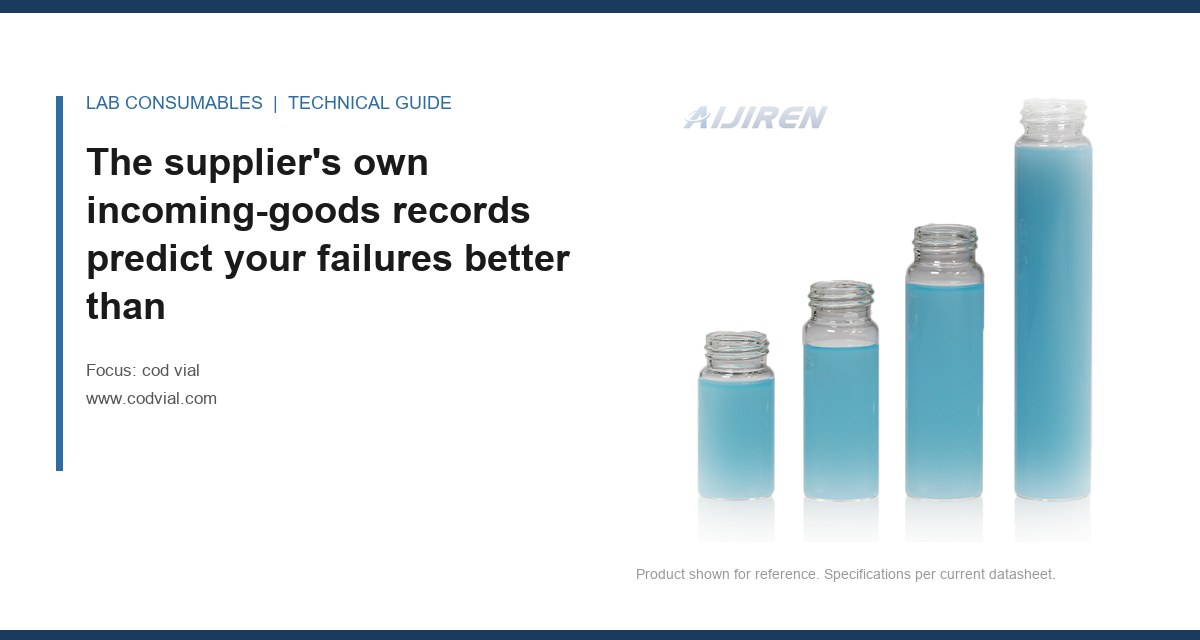
A lot of 40 mL COD vials failed our internal release check last March because the septa punched through at 22 lb instead of the 30 lb minimum we specify, and the supplier’s certificate of analysis said nothing about it. That number, 22 lb, is the reason I now treat a supplier audit as a document review first and a factory tour second. If you are building a cod vial supplier audit checklist, the items that predict failure are almost never the ones the sales rep puts in the slide deck. They are buried in the control plan, the gauge R&R study, and the last three months of nonconformance logs.
I have run this audit from both sides of the table, as a buyer and as a contract manufacturer. What follows is the checklist I actually use: the quality-system items that forecast trouble, the evidence I demand before anyone books a flight, and a scoring method that lets two buyers reach the same verdict on the same vendor.
The supplier’s own incoming-goods records predict your failures better than their finished-goods COA
A certificate of analysis tells you what a vendor chose to test on the day they shipped. Their incoming-goods inspection records tell you whether they can hold a specification across lots. Ask for the last twelve months of incoming inspection data on the three components that matter: the borosilicate tubing, the PTFE-faced silicone septum, and the open-top cap.
Here is what I look for. On the glass, the wall thickness distribution should be reported as a capability index, not a min/max. A Cpk below 1.33 on wall thickness at the 40 mL shoulder means the forming process is drifting, and you will see dimensional stack problems at the crimp. On the septum, I want the durometer and the compression-set data at the actual use temperature. A septum rated to 200 °C that shows 18% compression set after 24 hours at 180 °C is a septum that will leak on your autosampler tray by the time the run finishes.
If the vendor cannot produce twelve months of incoming data because they buy finished vials and only assemble, that is a finding in itself. It changes the audit from a manufacturing audit to a distribution audit, and the checklist shifts to traceability and lot segregation. The cod vial you buy from a distributor still has a factory behind it, and you need to know which one.
Evidence to request before the audit, so the visit is not a first look
I send a pre-audit evidence pack request with a 10-business-day deadline. If the vendor stalls, the audit is already telling you something. The pack has four parts.
- Control plan and process flow for the specific vial size and closure combination you buy, not a generic family document. It must name the gauge, the frequency, and the reaction plan for each critical characteristic.
- Gauge R&R and capability studies on the critical-to-quality dimensions: crimp diameter, septum thickness, cap skirt height, and puncture force. A gauge R&R above 30% of tolerance means the vendor cannot reliably measure the thing they are promising.
- Nonconformance and CAPA log for the last 24 months, with the disposition of each event. I want to see whether they closed the root cause or just reworked the lot.
- Change-control procedure and a list of every change to the septum compound, glass source, or cap resin in the last three years. Undisclosed compound changes are the single most common cause of a method suddenly failing on a lot that “should be identical.”
I also ask for the calibration certificates on the force gauge used for puncture testing and the torque tester used on the crimp. If those two instruments are out of calibration, every number in the COA is a guess. This is the kind of evidence that separates a real quality system from a folder of pretty certificates.
Score the vendor on process control, not on the brochure
I score every candidate on a 100-point scale with fixed weights. The weights matter more than the questions, because they force the buyer to decide in advance what actually causes field failures. Here is the version I use for COD vial vendors.
| Audit area | Weight | What earns full marks | What scores zero |
|---|---|---|---|
| Septum puncture force control | 20 | In-process check every 500 pcs, force gauge calibrated, Cpk ≥ 1.33 on 30 lb nominal | Only a finished-goods COA, no in-process data |
| Glass dimensional capability | 15 | Cpk ≥ 1.33 on crimp OD and wall thickness, monthly capability study | Min/max only, no capability index |
| Change control | 15 | Written procedure, customer notification before change, 3-year change log | Verbal assurance that “nothing has changed” |
| Traceability and lot segregation | 15 | Lot code links to glass lot, septum lot, and assembly date; quarantine area physically separated | Lot code on carton only, no link to components |
| Nonconformance and CAPA | 15 | 24-month log, root-cause verified, effectiveness check documented | No log, or log shows repeated same-cause events |
| Calibration and gauge R&R | 10 | All critical gauges in calibration, R&R under 30% | Calibration lapsed on force or torque instruments |
| Cleanroom and handling | 10 | Class 100,000 or better for septum handling, gowning procedure, particle counts logged | Open assembly area, no particle monitoring |
A vendor below 75 does not get a trial order. Between 75 and 85 gets a conditional approval with a 90-day re-audit. Above 85 with no open major findings gets full approval. I have walked away from vendors that scored 90 on presentation and 62 on this sheet, and the sheet was right every time.
Three field cases where the audit caught what the COA hid
Case 1: the 22 lb septum that passed the COA
A vendor’s COA listed puncture force as “30 lb typical.” Our incoming check on a 30-piece sample gave a mean of 22 lb and a standard deviation of 3.1 lb. The measurement that identified it was a simple force-gauge pull on 30 randomly selected vials from three cartons. The fix was not a new supplier. It was a septum compound change the vendor had made six months earlier to reduce cost, never disclosed, and never re-validated. We now require a 30-piece puncture force check on every incoming lot with an accept/reject at 27 lb minimum, and we hold the vendor to the change-control clause in the audit.
Case 2: the crimp that leaked only on the autosampler
A customer reported low COD recoveries on a specific instrument. The vials passed a manual pressure-decay leak test at the vendor. The audit finding was the crimp diameter capability: Cpk of 0.91 against a 0.5 mm tolerance band. The vials were within spec on average but the tail of the distribution was under-crimped, and the autosampler’s gripper was deforming those vials during transport. The fix was a crimp-diameter capability requirement in the purchase specification and a 100% inline vision check at the vendor. This is the kind of defect a finished-goods COA will never show you, because the sample is too small and the test is too gentle.
Case 3: the ghost peak traced to a septum lot
One of our GC customers saw a siloxane ghost peak that did not scale with injection volume. The audit trail led to a septum lot where the vendor had switched silicone suppliers without notification. The measurement was a solvent extraction blank on 10 septa from the suspect lot compared against a retained reference lot. The fix was a retained-sample program on both sides: we keep a sealed reference lot of every approved septum batch for 24 months, and the vendor must notify us in writing before any compound change. The Restek technical library has good background on how septa bleed shows up in chromatograms if you need the mechanism.
The closure is where most audits should spend their time
The glass is a commodity. The closure is where the money and the risk live. When I audit a COD vial vendor, I spend at least half the evidence review on the septum and the cap, because that is where the failure modes concentrate.
Ask for the septum compound datasheet, not just the finished-part spec. You want the base polymer, the durometer (typically 45 to 55 Shore A for a 40 mL COD closure), the compression set at temperature, and the extractables profile. A PTFE-faced silicone septum rated to 200 °C is standard for COD because the digestion runs at 150 °C for two hours. If the vendor cannot tell you the compression set at 150 °C after 24 hours, they have not characterized the part for your application.
On the cap, ask for the resin grade and the torque-to-seal data. A 40 mL open-top cap typically seals between 1.5 and 2.5 in-lb of applied torque depending on the crimper. If the vendor’s cap skirt height varies by more than 0.2 mm, your crimper will either under-seal or crack the glass. The 2 mL vial line uses the same closure logic at a smaller scale, and the dimensional discipline carries over.
One more item: the septum lot traceability. I want the septum lot number stamped on the bag, not just the carton. If a ghost peak shows up six months later, I need to pull every vial from that septum lot out of inventory. Without bag-level lot codes, that is impossible.
What a clean audit still does not tell you
An audit is a snapshot. It tells you the vendor’s system was in control on the day you visited. It does not tell you what happens on the third shift in August. That is why the audit score should set the incoming inspection level, not replace it.
My rule: a vendor scoring above 85 goes to reduced inspection (AQL 1.0, sample size per ANSI/ASQ Z1.4 general inspection level II). A vendor between 75 and 85 stays at normal inspection (AQL 0.65). A vendor below 75 does not ship to us. The audit sets the sampling plan, and the sampling plan catches the drift the audit cannot see. I also require a quarterly data review: the vendor sends their capability indices and nonconformance summary every 90 days, and we compare against the audit baseline. A Cpk that drops from 1.5 to 1.1 between reviews is an early warning that costs nothing to catch.
This is also where the HPLC consumables supply chain and the COD vial supply chain diverge. HPLC consumables are often bought on price and lead time because the failure is visible immediately. COD vials fail silently, in a digestion block, two hours after you stopped watching. That asymmetry is why the audit weights process control so heavily.
The audit checklist items that map to real standards
When a vendor pushes back on the depth of the audit, I point to the standards their own quality system should already reference. A COD vial vendor making claims about method suitability should be able to show you how their product supports the requirements in EPA SW-846 and the relevant AOAC digestion methods. They do not have to run the method, but they should know which dimensional and closure characteristics the method depends on.
For the dimensional side, ask whether they work to a drawing with GD&T callouts and whether the drawing is revision-controlled. A crimp diameter callout of 28.0 ± 0.25 mm on a 40 mL vial is meaningless if the drawing revision in the vendor’s system is three years old. I have seen a vendor ship against a superseded drawing for eight months because the revision control was a shared folder with no sign-off. That is a 15-point hit on the change-control line, and it is exactly the kind of finding an audit is for.
For closure performance, ask for the septum’s USP <381> elastomeric closure data if they make any claim about pharmaceutical use, and for the extractables study if they supply to environmental labs running trace organics. The Agilent consumables documentation and the Thermo Fisher chromatography resources are useful references for what a credible closure datasheet looks like. If your vendor’s datasheet is thinner than a column datasheet, ask why.
The decision rule
Approve a COD vial vendor only when the pre-audit evidence pack is complete, the weighted audit score is 85 or higher with no open major findings, and the vendor has demonstrated a capability index of at least 1.33 on crimp diameter and septum puncture force from their own in-process data. Set incoming inspection at AQL 1.0 for that vendor and review their capability data every 90 days. If any of those three conditions fails, the vendor goes on conditional status or does not ship, regardless of how good the price looks. The audit is not a relationship exercise. It is a filter, and the number it produces should decide who fills your digestion block.
References & further reading
Related resources from our lab consumables network:
- Cod Vial at codvial.com
- Vial Insert at hplcinsert.com
- 2Ml Vial at 2mlsamplevial.com
- Hplc Consumables at hplcconsumable.com
External references and standards: